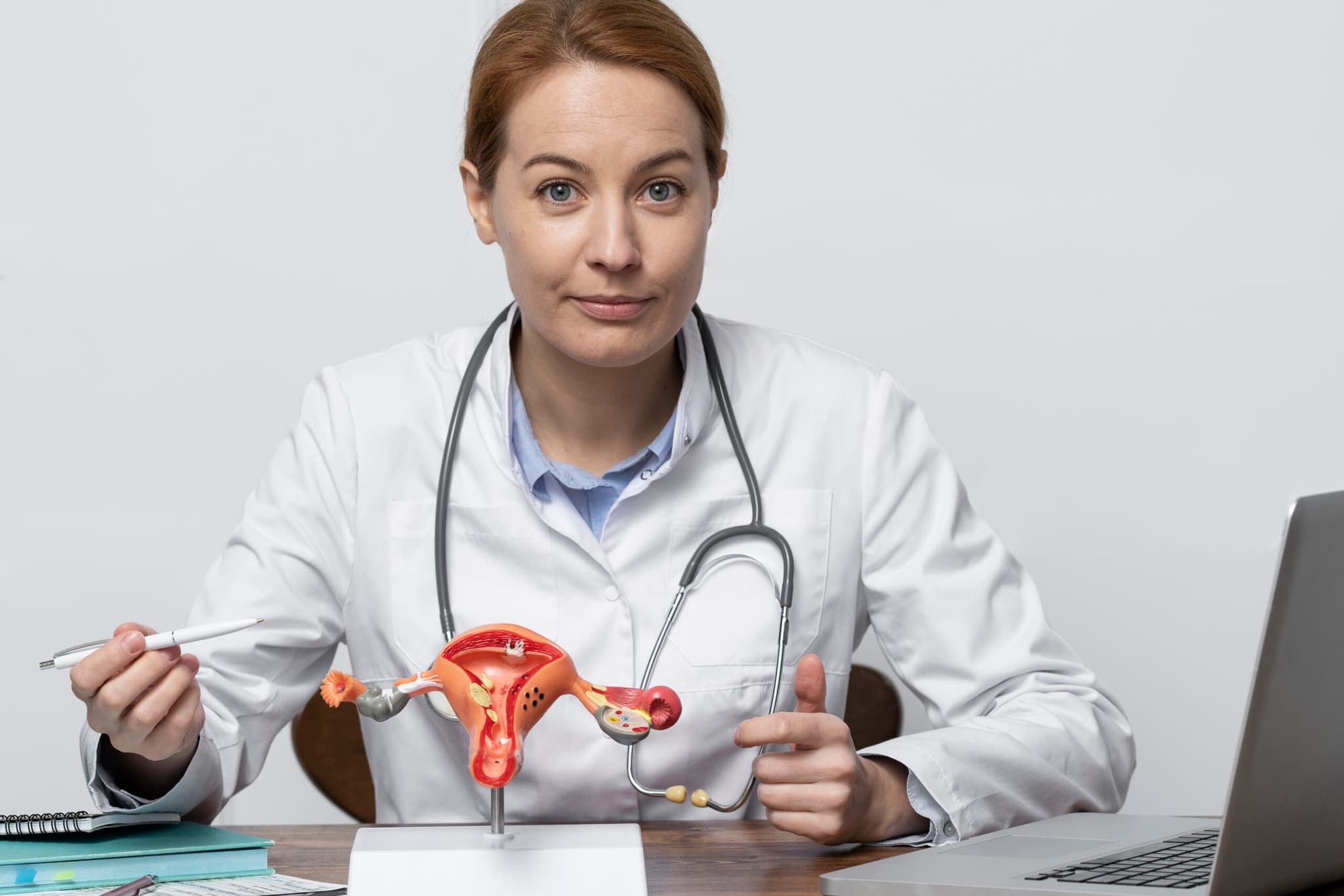


Your waistband sits differently than it did two years ago. From the side, your lower abdomen has a curve that was not there before, and it does not shift regardless of what you eat or how much you exercise. Someone may have asked whether you are expecting. You laughed it off, and then thought about it for the rest of the week.
The distinction that matters here is between soft and firm. Weight and digestive bloating are soft, fluctuate through the day, and respond over time to changes in diet and activity. An enlarged uterus is firm, sits low in the abdomen below the navel, does not fluctuate the way bloating does, and does not respond to any of it — because it is not fat or gas, it is an organ occupying more space than it used to.
At Seamless Medical Centers, Dr. Zagum Bhatti, Board-Certified Interventional Radiologist and Founder & Chief Medical Officer of Seamless Medical Centers, this is one of the symptoms women mention last and have often thought about longest. It tends to be raised at the end of an appointment, framed as an aside, when it is frequently the thing that prompted the appointment in the first place.
What Is Actually Happening
A uterus containing fibroids can enlarge considerably. When it does, it has nowhere to expand except upward and outward into the abdomen, which produces a visible change in the lower abdominal profile. A substantially enlarged uterus can reach a size comparable to several months of pregnancy, which is why the resemblance is so often noticed and remarked on. Our guide to enlarged uterus symptoms covers the finding itself and its causes.
Where the fibroids sit determines how the change looks. Fibroids growing outward from the front or top of the uterus produce the most visible abdominal change, sometimes asymmetrically, so that one side appears fuller than the other. Fibroids growing into the cavity may cause substantial bleeding while producing almost no visible change at all. This is why two women with similar imaging can have completely different experiences of how their body looks.
Position also explains why the change is not always symmetrical. A single large fibroid on one side of the uterus produces a fuller contour on that side, which women sometimes notice first when clothing sits unevenly or when lying down. This can be unsettling to discover, and it is worth knowing that asymmetry is a normal consequence of where a fibroid happens to sit rather than a sign of anything unusual in itself.
The change is usually gradual. Fibroids typically grow slowly, and the abdomen adjusts in step, which is why most women cannot identify when it started. It is generally noticed indirectly — clothes that stopped fitting, a photograph, a comment — rather than observed day to day.
Why Diet and Exercise Do Not Change It
This is the part worth being clear about, because a great deal of time gets lost here. Diet and exercise act on body fat and on digestive contents. Neither has any effect on the volume of an organ inside the pelvis. A woman can lose a considerable amount of weight and find her lower abdomen essentially unchanged, because what she is seeing was never fat.
That experience is commonly interpreted as personal failure, and it is not. It is a straightforward mismatch between the intervention and the cause. If your abdomen has not responded to sustained, sensible effort, the most likely explanation is that you have been addressing the wrong mechanism — not that you have not tried hard enough.
There is a practical marker worth knowing. Digestive bloating tends to be worse later in the day and better in the morning, and varies with what you have eaten. Uterine enlargement is essentially the same on waking as at bedtime and does not track with meals. If your lower abdomen looks much the same first thing in the morning as it does at night, that consistency points away from a digestive explanation.
The Symptoms That Usually Come With It
Visible change rarely arrives alone, and the accompanying symptoms are what make the picture coherent. Heavier or longer periods are the most common companion, and our guide to heavy menstrual bleeding sets out where the thresholds sit. A persistent sense of pelvic pressure or heaviness frequently accompanies it, covered in our guide to pelvic pressure and fibroid bulk symptoms.
Bladder symptoms are common where the enlargement presses forward, and bowel symptoms where it presses backward — covered in our guides to fibroid-related urinary symptoms and bowel pressure and constipation. Feeling full after eating relatively little is another frequent complaint, because there is simply less room for the stomach to expand.
There is a further cost that rarely gets recorded anywhere. Women describe avoiding fitted clothing, declining swimming, dressing to conceal, and fielding questions about pregnancy from people who mean no harm. None of that appears in a set of notes, and it is often the part carried longest. It is legitimate information about how much the condition is affecting you, and it belongs in the conversation rather than being filtered out as not properly medical.
Mention these together when you are seen. A woman describing abdominal change alone may be given dietary advice. The same woman describing abdominal change alongside periods that have doubled in heaviness and a constant sense of pelvic pressure is describing something that warrants imaging, and it is the combination that makes that obvious.
What Else Causes Lower Abdominal Change
One further distinction is worth drawing, because it changes how urgently something should be looked at. Change that has developed slowly over years, alongside gradually heavier periods, fits the fibroid picture well. Change that has appeared over weeks rather than months, or that comes with pain, appetite loss, or feeling unwell, does not fit that pattern and warrants prompt assessment rather than a routine appointment. The speed of the change is as informative as the change itself.
Fibroids are one explanation among several, which is why assessment rather than assumption is the right response. Adenomyosis enlarges the uterus more uniformly and typically produces heavy, painful periods. Ovarian cysts and other pelvic masses can produce abdominal distension and are assessed differently. Digestive conditions produce genuine bloating that varies through the day. Weight distribution changes with age and hormonal shifts, and more than one of these can be true at once.
It is worth naming the anxiety that visible abdominal change tends to produce, because it is frequently what delays women from asking. This is not a reason to assume the worst — the large majority of lower abdominal enlargement in women of reproductive age is explained by benign conditions, fibroids among the most common — but a firm change that has developed over months, particularly alongside a change in your bleeding, is a reason to be assessed rather than to keep trying to address it yourself.
How This Is Assessed

Are You a Candidate for PAD Treatment?
If you answer "yes" to any of these questions, you may be a candidate for this treatment.
Call Now — (409) 213-9575Question 1 of 4
Have you been diagnosed with Peripheral Artery Disease (PAD) by a doctor?
Prefer to talk? Call (409) 213-9575
Your information is protected under HIPAA. We will never share your data.
Assessment is usually straightforward. A physical examination can identify an enlarged uterus and whether it feels smooth or irregular. A pelvic ultrasound establishes whether fibroids are present, how large, and where they sit. Where the uterus is substantially enlarged and individual fibroids are difficult to separate, MRI gives clearer detail. Our guide to how fibroids are diagnosed sets out the full sequence.
Position is the detail that connects the imaging to what you are seeing, and it is worth locating in your own report. Fibroids described as subserosal or as sitting on the anterior or fundal surface are the ones most likely to be producing visible change. Our guide to reading your fibroid imaging explains the terminology.
Describe what you have noticed plainly and without apology. Clothes that no longer fit, a change in profile, a firmness you can feel lying down. These are clinical observations, not vanity, and they are relevant information about the size of an organ. Women routinely downplay this symptom because it feels like a complaint about appearance, and downplaying it makes it easier to overlook.
What Treatment Can and Cannot Be Expected to Do
Because the change is caused by volume, treatments that reduce fibroid volume are the ones that address it. Uterine fibroid embolization blocks the arterial supply feeding the fibroids so they shrink over the months that follow, while preserving the uterus. Myomectomy removes fibroids surgically, and hysterectomy removes the uterus.
Being realistic here matters more than in most areas. For appropriate candidates, many patients experience meaningful reduction in pressure symptoms and bleeding. Changes in abdominal appearance vary considerably between women and depend on fibroid size, number, position, and body composition, and they occur gradually over months rather than immediately. Individual results may vary. Treatment is directed at symptoms rather than appearance, and appearance change should be understood as a possible secondary effect rather than the goal. Our overview of how uterine fibroid embolization works and who it helps covers candidacy.
If you are weighing options, our comparisons of UFE and hysterectomy and UFE and myomectomy set out the differences in recovery and fertility implications. And if this symptom has been affecting how you feel about your body, that is a reasonable thing to say out loud at consultation — it is relevant to how much the symptoms are costing you, which is part of what any treatment decision weighs.
Frequently Asked Questions About Fibroid Belly
Can fibroids make you look pregnant?
A uterus substantially enlarged by fibroids can reach a size comparable to several months of pregnancy, producing visible lower abdominal change. It is firm rather than soft, sits below the navel, and does not fluctuate through the day the way digestive bloating does.
What does fibroid belly feel like?
Usually firm rather than soft, sitting low in the abdomen below the navel. Some women can feel a distinct mass, particularly lying down. It is often accompanied by a sense of pressure or heaviness that persists throughout the month.
How do I know if it is fibroids or weight gain?
Weight is distributed more generally and is soft; an enlarged uterus is localised low in the abdomen and firm. Digestive bloating varies through the day and with meals, while uterine enlargement stays essentially the same. Accompanying symptoms such as heavier periods make a uterine cause more likely.
Why has my stomach not changed despite diet and exercise?
Diet and exercise act on body fat and digestive contents, neither of which is what you are seeing if the cause is an enlarged uterus. The lack of response is a mismatch between the intervention and the cause rather than a lack of effort.
Will my stomach go back to normal after treatment?
Changes in appearance vary considerably between women and depend on fibroid size, number, position, and body composition. Any change occurs gradually over months. Treatment is directed at symptoms rather than appearance, and appearance change is best understood as a possible secondary effect.
Should I see someone about this if I have no other symptoms?
A firm lower abdominal change that has developed over months is reasonable grounds for assessment on its own. A pelvic examination and ultrasound are straightforward, and establishing the cause is more useful than continuing to address it as a weight or dietary issue.
Is UFE appropriate if I want to become pregnant?
Uterine fibroid embolization is generally not recommended as a first-line option for women planning future pregnancy; myomectomy is typically preferred in that situation. Raise your fertility plans at consultation so the recommendation reflects them.
Talk to a Specialist About Your Symptoms
If your lower abdomen has changed and nothing you have tried has made a difference, Contact Seamless Medical Centers to discuss your options. An evaluation establishes what is driving your symptoms and what can reasonably be done about it.
Phone: 409-213-9575
Address: 3300 Jimmy Johnson Blvd, Suite #130, Port Arthur, Texas 77642
Medical Disclaimer
Individual results may vary. This information is for educational purposes only and should not replace professional medical advice. Treatment decisions should be made in consultation with qualified healthcare providers.
Published by Seamless Medical Centers | Clinical information reflects the expertise of Dr. Zagum Bhatti, MD, Board-Certified Interventional Radiologist, Founder of Seamless Medical Centers.
Why Choose Seamless Medical Centers?
- Minimally Invasive: Most procedures require only a small incision and are performed as outpatient services.
- Expert Care: Board-certified interventional radiologists with extensive training and experience.
- Faster Recovery: Less downtime compared to traditional surgery, getting you back to your life sooner.
- Advanced Technology: State-of-the-art imaging and treatment equipment for precise, effective care.
- Patient-Centered: Personalized treatment plans tailored to your unique needs and goals.
Published by Seamless Medical Centers
Clinical information on this site is based on the expertise of Zagum Bhatti, M.D. — Board Certified in Interventional Radiology/Diagnostic Radiology (American Board of Radiology), dual-fellowship-trained (Neuroradiology; Vascular & Interventional Radiology, Rush University Medical Center), former Assistant Professor of VIR at UTHealth Houston, and Founder & Chief Medical Officer of Seamless Medical Centers.
Why Choose Seamless Medical Centers?
- Minimally Invasive: Most procedures require only a small incision and are performed as outpatient services.
- Expert Care: Board-certified interventional radiologists with extensive training and experience.
- Faster Recovery: Less downtime compared to traditional surgery, getting you back to your life sooner.
- Advanced Technology: State-of-the-art imaging and treatment equipment for precise, effective care.
- Patient-Centered: Personalized treatment plans tailored to your unique needs and goals.