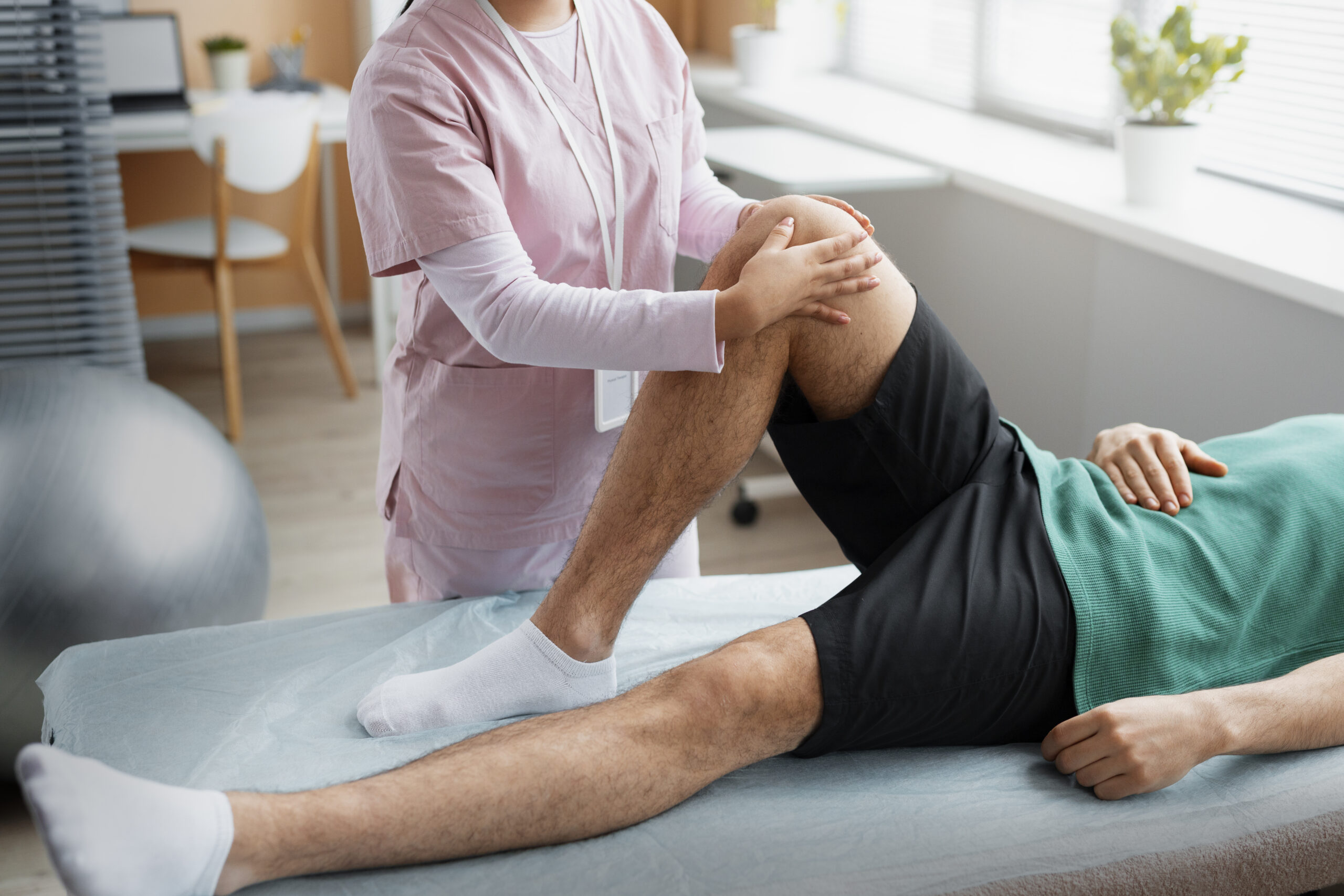


Flat ground feels fine. You can walk the block, do the grocery store, get through most of your day without thinking about your knee at all. Then you reach a staircase, and there it is — a sharp catch or a deep ache, right around or behind the kneecap, on every step up. Maybe going down is even worse. At Seamless Medical Centers, patients describe this pattern all the time, usually with the same puzzled question: why do stairs hurt when walking does not?
Start with the benchmark. Mild, occasional knee soreness after an unusually active day — a long hike, a day of yard work — is ordinary and typically fades within a day or two. Knee pain that shows up on most trips up the stairs, that has persisted for more than a few weeks, that is forcing you to lead with one leg or pull on the railing, or that comes with swelling, stiffness, grinding, or buckling is a different category. That pattern is not ordinary wear from a busy week; it is a signal from a specific structure in your knee, and it is worth understanding which one.
Why Stairs Hurt When Walking Does Not
The answer is mechanical. When you walk on level ground, the joint between your kneecap (patella) and thigh bone (femur) carries a load roughly comparable to your body weight. When you climb stairs, your knee bends deeply under load while the thigh muscles pull the kneecap hard against the femur — and the force across that patellofemoral joint multiplies to several times your body weight. Descending stairs is often worse still, because the same muscles are working to control your descent while the joint is compressed.
That multiplication effect is why stairs act as an early-warning system for the knee. A joint surface that is mildly irritated or worn can handle one times body weight without complaint but protests at three or four times. It is also why stair pain so consistently points to the front of the knee — the kneecap joint and the cartilage behind it are exactly the structures the stair-climbing load compresses.
Two conditions account for most persistent stair pain, and they sit at different points in life. The first is patellofemoral pain syndrome, an irritation of the kneecap joint common in younger and more active people. The second is knee osteoarthritis, the gradual wearing of joint cartilage that becomes increasingly common from middle age onward. They can feel similar on a staircase, but they are different problems with different treatments — which makes telling them apart the most useful thing you can do next.
Kneecap Pain or Arthritis? How to Tell the Difference
Patellofemoral pain syndrome — sometimes called runner’s knee — produces a dull ache or sharp catch at the front of the knee, around or behind the kneecap. It flares with stairs, squatting, kneeling, and running, and it has a signature: pain after sitting with bent knees for a long stretch, sometimes called the theater sign. It is most common in runners, in people who recently increased their activity, and in younger adults generally. Swelling is usually minimal, and the knee typically feels normal at rest. Contributing factors include muscle imbalance around the hip and thigh, alignment, and training load.
Knee osteoarthritis tells a different story. It develops gradually, usually from the forties and fifties onward, as the cartilage cushioning the joint wears down and the joint becomes inflamed. Stair pain is one of its earliest and most reliable signals — often appearing on stairs months or years before flat-ground walking is affected. The accompanying pattern is distinctive: stiffness after rest that loosens with movement, aching that worsens by the end of an active day, grinding or creaking sensations, and episodes of swelling. If your knee also feels tight or hard to bend first thing in the morning, our guide to the causes of a stiff knee covers that overlapping picture, and if visible puffiness comes and goes, our guide to the causes of a swollen knee explains what fluid in the joint means.
Age is a useful starting clue but not a verdict — active people in their fifties get patellofemoral pain, and osteoarthritis can begin earlier than people expect, particularly after old knee injuries. Other causes contribute too: cartilage softening behind the kneecap, meniscus tears, and tendon irritation below the kneecap can each produce stair pain. When the pattern is persistent, an examination and, where appropriate, imaging settle the question — an X-ray shows the joint-space narrowing of arthritis, and the exam localizes which structure is actually generating the pain. Our full overview of knee pain causes and diagnosis walks through how doctors work through that process.
- [QUIZ WIDGET — “Are You a Candidate for GAE?” — recommended insertion point]
When Stair Pain Deserves an Evaluation
Watchful waiting is reasonable for pain that appeared after a clear overload — a new exercise program, a weekend of heavy lifting — and is fading week over week. Beyond that, the thresholds are practical. Get evaluated if stair pain has persisted for more than a few weeks despite backing off aggravating activity; if it is progressing from stairs into flat-ground walking; if the knee swells, locks, catches, or gives way; if pain wakes you at night; or if you are reorganizing your life around it — taking the elevator you never used to take, moving a bedroom downstairs, giving up activities you enjoy.
The reorganizing deserves emphasis, because it is the step people mistake for coping. Avoiding stairs does not treat the knee; it shrinks your world while the underlying condition continues on its own course. Patellofemoral pain responds well to targeted treatment, and osteoarthritis has more treatment options today than it did even a decade ago — but both respond better when addressed before the pattern has hardened into years of avoidance and progressive muscle weakening.
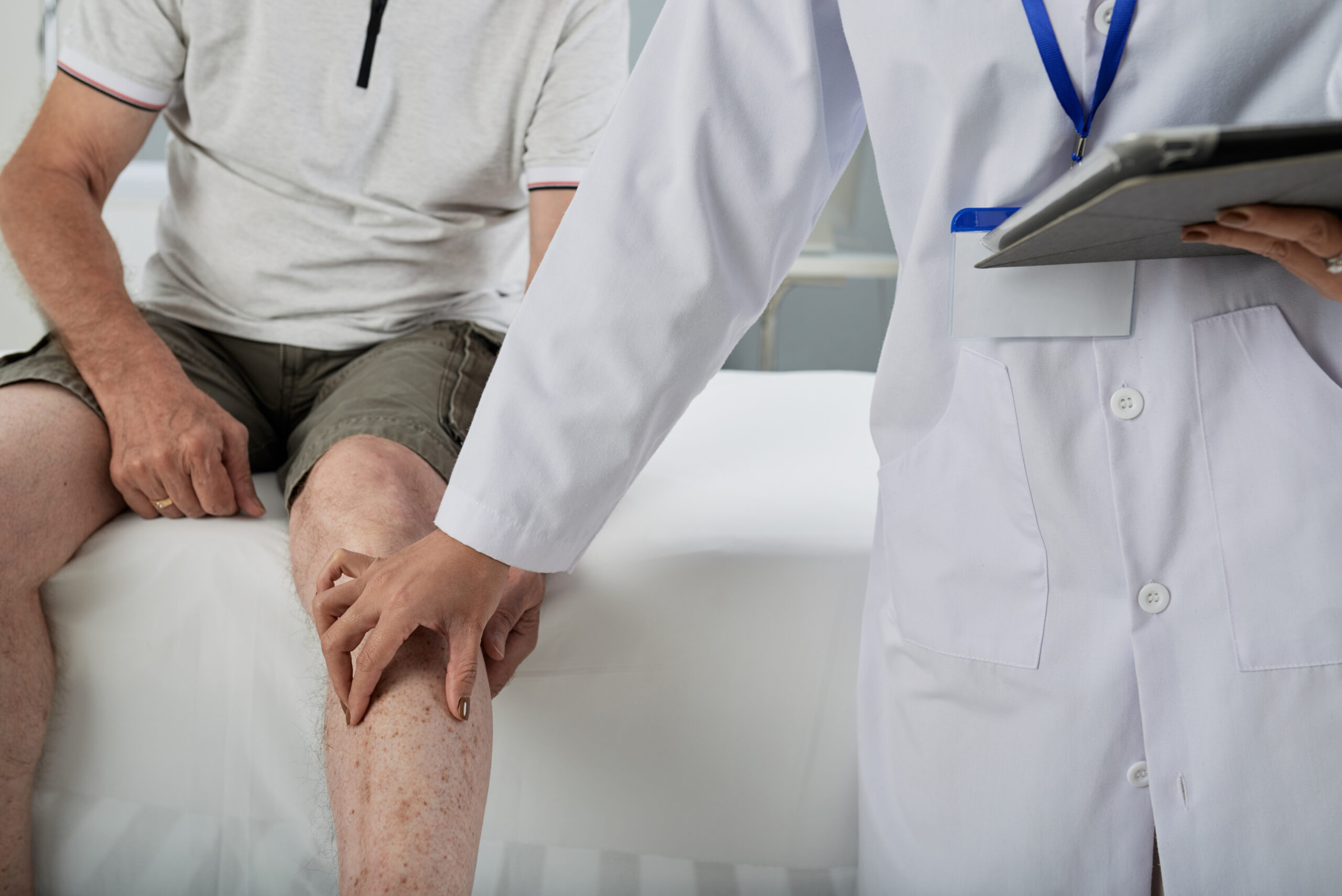
The evaluation itself is straightforward. Expect a conversation about when the pain began, which step of the stair motion hurts, and what else the knee has been doing — stiffness, swelling, catching. The physical exam localizes the pain to the kneecap joint, the joint line, or the tendons, and tests how the kneecap tracks as the knee bends. When the picture suggests arthritis or an internal problem, a standing X-ray is usually the first imaging step, because it shows cartilage loss as narrowing of the joint space; further imaging is reserved for cases where the exam points to a soft-tissue cause. Most patients leave that first visit with a working diagnosis and the outline of a plan.
Treatment: From Conservative Care to Non-Surgical Procedures
For patellofemoral pain syndrome, the mainstay is structured physical therapy that strengthens the muscles supporting the kneecap and corrects the mechanics that overload it, alongside sensible adjustments to activity and footwear. Most people with PFPS improve substantially with that approach, and your doctor or physical therapist can build a program suited to your pattern. Over-the-counter anti-inflammatory medication, when appropriate for you, can help manage flares while the underlying mechanics are corrected.

Are You a Candidate for GAE?
If you answer "yes" to any of these questions, you may be a candidate for this treatment.
Call Now — (409) 213-9575Question 1 of 3
In the past 48 hours, have you had moderate to severe knee pain?
Prefer to talk? Call (409) 213-9575
Your information is protected under HIPAA. We will never share your data.
For stair pain driven by knee osteoarthritis, treatment is a ladder. It typically begins with activity modification, weight management where relevant, physical therapy, and anti-inflammatory measures, and can progress to injections that reduce inflammation or supplement joint lubrication. These steps help many patients for a long time. The frustration comes when they stop helping — when injections wear off faster each round and the stairs keep getting harder — and the only remaining option presented is knee replacement surgery, which many patients are not ready for or cannot accommodate. Our guide to knee replacement alternatives maps the full set of joint-preserving options at that stage.
One of those options comes from interventional radiology. Genicular artery embolization is a minimally invasive, non-surgical procedure for chronic knee pain from osteoarthritis. Through a pinhole puncture, a catheter is guided to the small genicular arteries that feed the inflamed joint lining, and tiny particles reduce the abnormal blood flow that sustains the inflammation. The procedure is performed on an outpatient basis, requires no incision and no implant, and preserves the natural knee — many patients experience meaningful pain relief in the weeks that follow, though individual results vary. At Seamless Medical Centers in Port Arthur, Texas, Dr. Zagum Bhatti, Board-Certified Interventional Radiologist and Founder & Chief Medical Officer of Seamless Medical Centers, evaluates whether GAE fits your knee — and an honest evaluation includes the limits: GAE is a treatment for osteoarthritis-related knee pain, not for patellofemoral pain syndrome in younger, active patients, whose stair pain is best served by therapy that corrects the mechanics. For a broader look at where GAE sits among conservative and procedural options, our guide to non-surgical knee arthritis treatment lays out the whole landscape.
The Bottom Line on Stairs and Your Knees
Stairs are a stress test your knees take dozens of times a day, and persistent pain on that test is information, not just annoyance. In younger and more active people it usually means the kneecap joint is overloaded and needs retraining; from middle age onward it is one of the earliest reliable signals of osteoarthritis. Both explanations are common, both are treatable, and both reward early attention. If stairs have been hurting for more than a few weeks — or you have quietly started avoiding them — get the knee looked at. The goal is not just a diagnosis; it is getting back to taking the stairs without thinking about them.
Frequently Asked Questions (FAQs)
Why does my knee hurt going up stairs but not walking?
Climbing stairs loads the joint between your kneecap and thigh bone with several times your body weight, while level walking loads it far less. A mildly irritated or worn joint surface can tolerate walking but protests under the multiplied load of stairs — which is why stair pain is often the earliest signal of a kneecap-joint problem or early osteoarthritis.
Why does my knee hurt more going down stairs than up?
Going down stairs, your thigh muscles work to control your descent while the kneecap is pressed firmly against the femur, so the patellofemoral joint often experiences even higher stress than on the way up. Pain that is worst on the way down points strongly to the kneecap joint — either patellofemoral pain syndrome or cartilage wear behind the kneecap.
Is knee pain on stairs a sign of arthritis?
It can be. Stair pain is one of the earliest and most consistent symptoms of knee osteoarthritis, often appearing before pain with ordinary walking. It is more likely to be arthritis if you are middle-aged or older and also notice stiffness after rest, grinding sensations, aching after active days, or episodes of swelling. In younger, active people, the same stair pain more often reflects patellofemoral pain syndrome. An exam and, when appropriate, an X-ray can tell the difference.
When should I see a doctor about knee pain on stairs?
See a doctor if the pain has persisted more than a few weeks despite easing off aggravating activity, is spreading into flat-ground walking, comes with swelling, locking, catching, or giving way, wakes you at night, or has you routinely avoiding stairs. Persistent stair pain is a treatable signal, and earlier evaluation preserves more options.
Can genicular artery embolization help knee pain on stairs?
It depends on the cause. GAE treats chronic knee pain from osteoarthritis by reducing the abnormal blood flow that feeds inflammation in the joint lining, and stair pain is often a prominent osteoarthritis symptom. GAE is not a treatment for patellofemoral pain syndrome in younger, active patients — that condition responds best to structured physical therapy. An evaluation with imaging determines which condition you have and whether you may be a candidate for GAE.
Should I stop using stairs if my knee hurts?
Briefly reducing aggravating activity is reasonable during a flare, but long-term stair avoidance is not a treatment — it weakens the muscles that support the knee and shrinks your routine while the underlying cause continues. The better path is identifying the cause and treating it, so stairs stop being something you plan around. Your doctor or physical therapist can guide how much activity is right during treatment.
Schedule Your Consultation
If stairs have become the hardest part of your day, find out what is actually driving the pain — and whether a non-surgical treatment fits. Schedule your consultation with Seamless Medical Centers to explore your knee pain treatment options. Most major plans accepted, including Medicare/Medicaid — we verify before your visit.
Phone: 409-213-9575
Address: 3300 Jimmy Johnson Blvd, Suite #130, Port Arthur, Texas 77642
Medical Disclaimer
Individual results may vary. This information is for educational purposes only and should not replace professional medical advice. Treatment decisions should be made in consultation with qualified healthcare providers.
Published by Seamless Medical Centers | Clinical information reflects the expertise of Dr. Zagum Bhatti, MD, Board-Certified Interventional Radiologist, Founder of Seamless Medical Centers.
Why Choose Seamless Medical Centers?
- Minimally Invasive: Most procedures require only a small incision and are performed as outpatient services.
- Expert Care: Board-certified interventional radiologists with extensive training and experience.
- Faster Recovery: Less downtime compared to traditional surgery, getting you back to your life sooner.
- Advanced Technology: State-of-the-art imaging and treatment equipment for precise, effective care.
- Patient-Centered: Personalized treatment plans tailored to your unique needs and goals.
Published by Seamless Medical Centers
Clinical information on this site is based on the expertise of Zagum Bhatti, M.D. — Board Certified in Interventional Radiology/Diagnostic Radiology (American Board of Radiology), dual-fellowship-trained (Neuroradiology; Vascular & Interventional Radiology, Rush University Medical Center), former Assistant Professor of VIR at UTHealth Houston, and Founder & Chief Medical Officer of Seamless Medical Centers.Read Dr. Bhatti’s full profile →
Why Choose Seamless Medical Centers?
- Minimally Invasive: Most procedures require only a small incision and are performed as outpatient services.
- Expert Care: Board-certified interventional radiologists with extensive training and experience.
- Faster Recovery: Less downtime compared to traditional surgery, getting you back to your life sooner.
- Advanced Technology: State-of-the-art imaging and treatment equipment for precise, effective care.
- Patient-Centered: Personalized treatment plans tailored to your unique needs and goals.