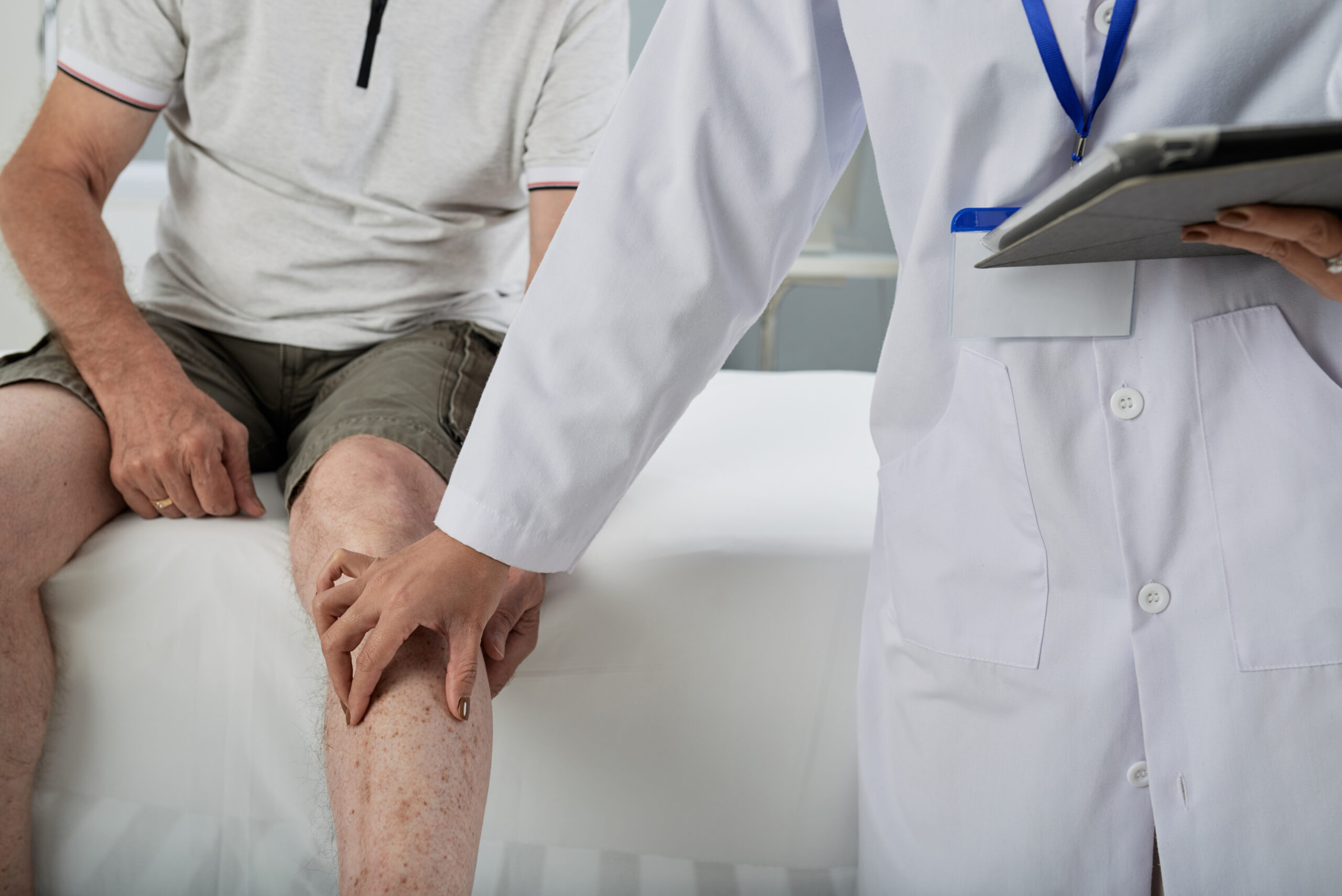


“Bone on bone” may be the most discouraging phrase in orthopedics. It usually arrives at the end of an X-ray review, and patients tend to hear it as a verdict: the cartilage is gone, the knee is finished, and the only real question left is when to schedule the replacement. If you are in Beaumont weighing exactly that conversation — turning over the weeks of rehabilitation, the time away from work or grandkids, maybe a surgeon’s waiting list — it is worth knowing that the verdict is less final than it sounds. At Seamless Medical Centers, we regularly evaluate Golden Triangle patients who were told their knee is bone on bone and who are not ready for, or not candidates for, replacement surgery. For many of them, there is a middle path.
A benchmark helps frame the decision. Knee replacement is genuinely the right answer for some knees — and it is elective in almost every case, which means timing is yours. The signal that you need to act on something is not the X-ray alone; it is pain that limits daily life despite months of conservative care: stairs surrendered, walks shortened, sleep interrupted, injections wearing off faster each round. If that is where you are, doing nothing is the one option that reliably fails. Doing surgery immediately, however, is not the only alternative to doing nothing.
What “Bone-on-Bone” Actually Means — and What It Does Not
Bone-on-bone is shorthand for advanced knee osteoarthritis: the cartilage cushioning part of the joint has worn to the point that, on a standing X-ray, the space between femur and tibia has narrowed severely or disappeared in places. It is a real, structural finding. What it is not is a precise predictor of pain. Two knees with near-identical X-rays can feel entirely different, because a large share of osteoarthritis pain comes not from bone contact itself but from chronic inflammation of the synovium — the joint’s lining — which is fed by an abnormal network of small blood vessels that develops as arthritis progresses.
That distinction matters enormously for your options. The structural damage cannot be reversed by anything short of replacing the joint surfaces — no honest treatment claims otherwise. But the inflammatory driver of pain can be targeted directly, which is why some patients with severe-looking X-rays get meaningful relief from treatments that never touch the bone. It also explains the familiar frustrations of the standard ladder: anti-inflammatory medication and injections calm the inflammation temporarily, and when they wear off, the supply lines feeding it are still there.
If your knee also swells periodically or feels tight after sitting, those are the same inflammatory process announcing itself — our guides to the causes of a swollen knee and why a knee feels stiff cover how those symptoms fit the arthritis picture.
The daily reality of a bone-on-bone knee needs no explanation to the person living it, but naming it clarifies the stakes: stairs taken one at a time with a hand on the rail, parking chosen by distance to the door, yard work rationed into short sessions, mornings that begin stiff and end swollen. For working people across the Golden Triangle — on plant floors, in warehouses, behind counters — a knee that cannot carry a full shift is not a lifestyle inconvenience, it is a livelihood problem. The same goes for the retirement you worked for: the fishing trips, the travel, the mornings on your feet with grandkids. That is the context in which “wait until you are ready for surgery” stops being a plan and starts being a gap that needs filling — years of function, spent waiting.
- [QUIZ WIDGET — “Are You a Candidate for GAE?” — recommended insertion point]
The Options Between “Live With It” and “Replace It”
The full menu of knee replacement alternatives runs from weight management and structured physical therapy, through bracing and anti-inflammatory measures, to injections that reduce inflammation or supplement joint lubrication. These steps help many patients for a long time, and they remain worth optimizing even with a bone-on-bone X-ray — stronger supporting muscles genuinely change how a worn knee feels. Our overview of non-surgical knee arthritis treatment maps that whole landscape and where each option earns its place.
The gap in that ladder has always been what to offer when injections stop lasting and surgery is not yet right — because of age, medical conditions, work that cannot pause for rehabilitation, or simple unreadiness. That gap is where interventional radiology now offers something specific: a procedure aimed at the abnormal blood vessels sustaining the inflammation itself.
Two of those conservative rungs are chronically underrated and worth stating plainly. Structured physical therapy strengthens the muscles that share the knee’s load — a stronger thigh and hip genuinely change how a worn joint feels, even when the X-ray never improves. And where it applies, modest weight loss subtracts multiplied pounds of force from every step and stair. Neither reverses arthritis, and neither is a moral test; they are mechanical levers, they cost little, and they make every other treatment — including any procedure — work better. A bone-on-bone finding is a reason to optimize them, not abandon them.
Genicular Artery Embolization: Targeting the Pain Supply Line
Genicular artery embolization is a minimally invasive, non-surgical procedure for chronic knee pain from osteoarthritis. Through a pinhole entry point — no incision, no implant — a catheter is guided to the small genicular arteries around the knee, and tiny particles reduce the abnormal blood flow feeding the inflamed joint lining. Less abnormal flow means less inflammation; less inflammation, for many appropriately selected patients, means meaningfully less pain in the weeks that follow. The knee itself is preserved, the procedure is outpatient under light sedation, and most patients return to light activity within days.
The honest framing matters here, and it is the same framing on our own patient pages: GAE is not a cure, it does not reverse joint damage, and it is not a replacement for surgery when surgery is clearly indicated. In a 2026 position statement, the Society of Interventional Radiology described GAE as a reasonable option for carefully selected patients with symptomatic knee osteoarthritis who have not gotten adequate relief from conservative care and who are not ready for — or are not candidates for — knee replacement. That description is precisely the Beaumont patient these paragraphs describe. Individual results vary, and candidacy depends on your imaging, your health history, and what has already been tried.

Are You a Candidate for GAE?
If you answer "yes" to any of these questions, you may be a candidate for this treatment.
Call Now — (409) 213-9575Question 1 of 3
In the past 48 hours, have you had moderate to severe knee pain?
Prefer to talk? Call (409) 213-9575
Your information is protected under HIPAA. We will never share your data.
At Seamless Medical Centers in Port Arthur, Texas, GAE evaluations and procedures are performed by Dr. Zagum Bhatti, Board-Certified Interventional Radiologist and Founder & Chief Medical Officer of Seamless Medical Centers. The consultation reviews your X-rays or MRI, your symptom history, and your prior treatments — and tells you plainly which category you fall into: a GAE candidate, a patient whose conservative ladder still has rungs left, or a knee that genuinely needs the surgeon.
It also helps to know what the procedure day and the weeks after look like. GAE is outpatient: local anesthesia with light sedation, a pinhole entry point, typically home the same day, and light activity within days — there is no surgical wound and no rehabilitation program to schedule life around. Some patients notice temporary skin discoloration over the treated area or a short-lived increase in soreness as the treated vessels close down; these generally settle on their own, and your care team explains exactly what to expect. Pain relief, when it comes, builds over the following weeks as the inflammation quiets rather than switching off overnight.
Come to the consultation with your ammunition: any knee X-rays or MRI on disc or in a portal, the list of what you have tried — therapy, braces, each type of injection and how long each round lasted — and an honest account of what the knee stops you from doing. That history is half the candidacy decision, and patients who bring it usually leave the first visit with a clear answer instead of a follow-up appointment.
Close to Home for the Golden Triangle
For Beaumont patients, this evaluation does not require a trip to a big-city hospital system. Seamless Medical Centers sees patients at one office — 3300 Jimmy Johnson Blvd, Suite #130 in Port Arthur, about 19 miles from Beaumont and roughly a 25-minute drive down I-10, whether you are coming from the West End, downtown, or out by Lamar University. Patients make the same short drive from Vidor, Orange, Nederland, and communities across Jefferson County. Our Beaumont knee pain treatment page has the visit details for your side of the trip.
A bone-on-bone X-ray narrows your options; it does not erase them. If your knee is dictating your days and replacement is a step you are not ready to take, find out whether the inflammation driving your pain can be treated directly. One consultation, 25 minutes from Beaumont, maps what is actually possible for your knee — including the honest answer if GAE is not it. Find out if you qualify.
Frequently Asked Questions (FAQs)
Does bone-on-bone knee pain always mean I need a knee replacement?
No. Bone-on-bone describes advanced cartilage loss on imaging, but the X-ray alone does not dictate treatment or timing — knee replacement is elective in nearly all cases. Much of arthritis pain comes from inflammation of the joint lining rather than bone contact itself, which is why some patients with severe X-rays get meaningful relief from joint-preserving treatments. The right path depends on your pain, function, health, and goals, not the image alone.
What is genicular artery embolization, in plain terms?
GAE is an outpatient, non-surgical procedure in which an interventional radiologist threads a thin catheter through a pinhole entry to the small arteries around your knee and releases tiny particles that reduce the abnormal blood flow feeding arthritis inflammation. Less inflammation typically means less pain. The joint is preserved, there is no incision or implant, and most patients return to light activity within days. Individual results vary.
Who is GAE not right for?
GAE is for osteoarthritis-related knee pain in carefully selected patients — typically those who have exhausted conservative care and are not ready for, or not candidates for, replacement. It is not a cure, it does not rebuild cartilage, and it is not a substitute for surgery when surgery is clearly the right answer. It may also be unsuitable with certain circulatory conditions or factors that make contrast imaging unsafe. The consultation determines candidacy honestly, including when the answer is no.
Where do Beaumont patients go for this — do I have to travel to Houston?
No. Evaluation and the procedure both happen at the Seamless Medical Centers office in Port Arthur, about 19 miles from Beaumont — roughly 25 minutes via I-10. There is one office, and it serves patients from Beaumont, Vidor, Orange, Nederland, and across the Golden Triangle; Houston-area patients are seen at our Port Arthur office as well.
My injections used to work but keep wearing off faster. Is that normal?
It is a common pattern in progressing osteoarthritis: injections calm inflammation temporarily, but the abnormal blood vessels sustaining that inflammation remain, so relief can shorten with each round. When injections stop lasting, it is a reasonable signal to have the fuller set of options evaluated — including whether treating the blood supply directly makes sense for your knee.
Schedule Your Consultation
If you have been told your knee is bone on bone and you are not ready for replacement, find out whether you are a candidate for genicular artery embolization. Schedule your consultation at our Port Arthur office. Most major plans accepted, including Medicare/Medicaid — we verify before your visit.
Phone: 409-213-9575
Address: 3300 Jimmy Johnson Blvd, Suite #130, Port Arthur, Texas 77642
Medical Disclaimer
Individual results may vary. This information is for educational purposes only and should not replace professional medical advice. Treatment decisions should be made in consultation with qualified healthcare providers.
Published by Seamless Medical Centers | Clinical information reflects the expertise of Dr. Zagum Bhatti, MD, Board-Certified Interventional Radiologist, Founder of Seamless Medical Centers.
Why Choose Seamless Medical Centers?
- Minimally Invasive: Most procedures require only a small incision and are performed as outpatient services.
- Expert Care: Board-certified interventional radiologists with extensive training and experience.
- Faster Recovery: Less downtime compared to traditional surgery, getting you back to your life sooner.
- Advanced Technology: State-of-the-art imaging and treatment equipment for precise, effective care.
- Patient-Centered: Personalized treatment plans tailored to your unique needs and goals.
Published by Seamless Medical Centers
Clinical information on this site is based on the expertise of Zagum Bhatti, M.D. — Board Certified in Interventional Radiology/Diagnostic Radiology (American Board of Radiology), dual-fellowship-trained (Neuroradiology; Vascular & Interventional Radiology, Rush University Medical Center), former Assistant Professor of VIR at UTHealth Houston, and Founder & Chief Medical Officer of Seamless Medical Centers.
Why Choose Seamless Medical Centers?
- Minimally Invasive: Most procedures require only a small incision and are performed as outpatient services.
- Expert Care: Board-certified interventional radiologists with extensive training and experience.
- Faster Recovery: Less downtime compared to traditional surgery, getting you back to your life sooner.
- Advanced Technology: State-of-the-art imaging and treatment equipment for precise, effective care.
- Patient-Centered: Personalized treatment plans tailored to your unique needs and goals.